
(English Below)
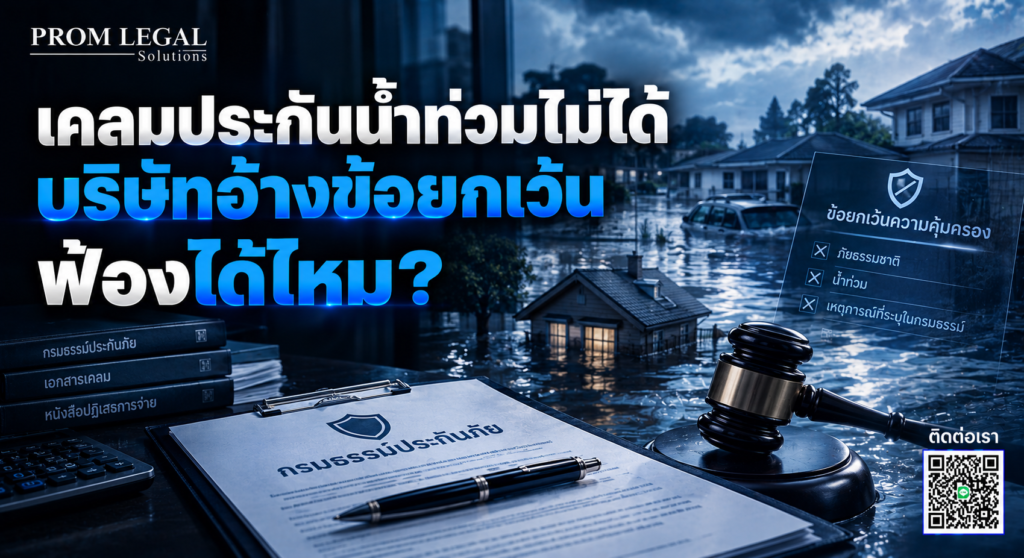
จ่ายเบี้ยประกันมาตลอดหลายปีด้วยความอุ่นใจ พอน้ำท่วมบ้าน รถ หรือร้านจริง ๆ กลับถูกบริษัทประกันปฏิเสธการจ่ายด้วยเหตุผลว่า “เข้าข้อยกเว้นตามกรมธรรม์” ความรู้สึกตอนนั้นเหมือนซื้อร่มไว้อย่างดี แต่พอฝนตกจริงกลับกางไม่ได้
คำถามคือ ถ้าโดนปฏิเสธเคลมแบบนี้ เราฟ้องได้ไหม? คำตอบคือ ฟ้องได้ค่ะ แต่โอกาสชนะขึ้นอยู่กับ “เนื้อหาในกรมธรรม์” และ “เหตุผลที่ใช้ปฏิเสธ” วันนี้ Prom Legal Solution ขอพาไปดูว่าปฏิเสธแบบไหนสู้ได้ แบบไหนสู้ยาก และมีช่องทางเรียกร้องสิทธิอย่างไร
ก่อนอื่นต้องเช็ก: กรมธรรม์ของเราคุ้มครองน้ำท่วมหรือเปล่า
นี่คือจุดตั้งต้นที่สำคัญที่สุด เพราะ “น้ำท่วม” ไม่ได้ถูกคุ้มครองอัตโนมัติในทุกกรมธรรม์
- ประกันอัคคีภัยบ้านพื้นฐาน โดยทั่วไป “ไม่รวม” ภัยน้ำท่วม ต้องซื้อความคุ้มครองภัยธรรมชาติหรือภัยน้ำท่วมเพิ่มเป็นพิเศษ
- ประกันรถยนต์ชั้น 1 โดยทั่วไปคุ้มครองความเสียหายจากน้ำท่วมในฐานะภัยธรรมชาติ เว้นแต่ผู้ขับจงใจขับฝ่าลุยน้ำหรือประมาทเลินเล่ออย่างร้ายแรง
- ประกันธุรกิจ/ทรัพย์สิน ต้องดูเงื่อนไขและวงเงินความคุ้มครองภัยน้ำท่วมในกรมธรรม์แต่ละฉบับ
ดังนั้นก่อนจะโกรธบริษัท ต้องเปิดกรมธรรม์ดูก่อนว่าเราซื้อความคุ้มครองน้ำท่วมไว้จริงหรือไม่
ปฏิเสธเคลมแบบไหน “พอสู้ได้” แบบไหน “สู้ยาก”
| ปฏิเสธแบบที่พอสู้ได้ | ปฏิเสธแบบที่สู้ยาก |
| บริษัทตีความข้อยกเว้น “กว้างเกินจริง” เพื่อเลี่ยงจ่าย | เราไม่ได้ซื้อความคุ้มครองภัยน้ำท่วมไว้ตั้งแต่ต้น |
| ข้อความในกรมธรรม์ “กำกวม” ตีความได้หลายทาง | ความเสียหายเกิดจากการจงใจหรือประมาทเลินเล่ออย่างร้ายแรงของผู้เอาประกัน |
| ข้อยกเว้นมีลักษณะเป็น “ข้อสัญญาที่ไม่เป็นธรรม” | ความเสียหายไม่ได้เกิดจากภัยที่กรมธรรม์คุ้มครอง |
| ประเมินค่าเสียหายต่ำกว่าความจริงอย่างไม่มีเหตุผล | ยื่นเคลมเกินอายุความหรือผิดเงื่อนไขเวลาแจ้งเหตุอย่างมีนัยสำคัญ |
จุดสำคัญคือ กรมธรรม์ประกันภัยเป็น “สัญญาสำเร็จรูป” ที่บริษัทเป็นผู้ร่างฝ่ายเดียว หากข้อความกำกวมหรือมีข้อสงสัย กฎหมายให้ ตีความไปในทางที่เป็นคุณแก่ผู้เอาประกัน ซึ่งเป็นฝ่ายที่ไม่ได้เป็นผู้กำหนดข้อความ (ป.พ.พ. มาตรา 11) และหากข้อยกเว้นใดไม่เป็นธรรมเกินสมควร ก็อาจถูกปรับให้ใช้บังคับได้เท่าที่เป็นธรรมตามพระราชบัญญัติว่าด้วยข้อสัญญาที่ไม่เป็นธรรม พ.ศ. 2540
ถ้าจะสู้ ต้องทำอย่างไร
- รวบรวมหลักฐานความเสียหาย ถ่ายรูป ถ่ายวิดีโอ เก็บใบเสร็จ ใบประเมินราคาซ่อม และหนังสือปฏิเสธการจ่ายจากบริษัท
- ร้องเรียนต่อ คปภ. สำนักงานคณะกรรมการกำกับและส่งเสริมการประกอบธุรกิจประกันภัย (คปภ.) มีกระบวนการรับเรื่องและไกล่เกลี่ยข้อพิพาทด้านประกันภัย ซึ่งมักจบได้เร็วกว่าการฟ้องศาล
- ฟ้องเป็นคดีผู้บริโภค ข้อพิพาทประกันภัยเป็นคดีผู้บริโภค ผู้เอาประกันฟ้องได้เองโดยไม่เสียค่าขึ้นศาล และภาระการพิสูจน์ข้อเท็จจริงที่อยู่ในความรู้เห็นเฉพาะของผู้ประกอบธุรกิจตกแก่บริษัทประกัน (มาตรา 29 แห่งพระราชบัญญัติวิธีพิจารณาคดีผู้บริโภค พ.ศ. 2551)
ข้อควรระวัง (เจ็บแต่จบ): การฟ้องเรียกค่าสินไหมทดแทนตามสัญญาประกันวินาศภัยมี อายุความ 2 ปีนับแต่วันเกิดวินาศภัย (ป.พ.พ. มาตรา 882) อย่ามัวแต่เจรจากับบริษัทไปเรื่อย ๆ จนเลยกำหนด และควรตอบโต้หนังสือปฏิเสธเป็นลายลักษณ์อักษรทุกครั้ง เพื่อรักษาสิทธิ
สรุป
- น้ำท่วมไม่ได้ถูกคุ้มครองทุกกรมธรรม์ ต้องเช็กก่อนว่าซื้อความคุ้มครองไว้หรือไม่ (อัคคีภัยพื้นฐานมักไม่รวม ส่วนรถชั้น 1 มักคุ้มครอง)
- ถ้าบริษัทปฏิเสธโดย ตีความข้อยกเว้นเกินจริง กำกวม หรือไม่เป็นธรรม ย่อมมีช่องสู้ เพราะกรมธรรม์ตีความเป็นคุณแก่ผู้เอาประกัน (ป.พ.พ. มาตรา 11)
- ช่องทางสู้คือ ร้อง คปภ. แล้วจึง ฟ้องคดีผู้บริโภค ที่ไม่เสียค่าขึ้นศาล และภาระพิสูจน์บางส่วนตกที่บริษัท (มาตรา 29)
- ระวัง อายุความ 2 ปี นับแต่วันเกิดวินาศภัย (ป.พ.พ. มาตรา 882)
การสู้คดีประกันต้องอาศัยการอ่านกรมธรรม์อย่างละเอียดและการวางรูปคดีที่ถูกต้อง Prom Legal Solution ให้บริการครบวงจร ทั้งตรวจเงื่อนไขกรมธรรม์และเหตุผลการปฏิเสธ ร้องเรียนต่อ คปภ. ไปจนถึงฟ้องคดีผู้บริโภคเรียกค่าสินไหมทดแทน ปรึกษาเราได้เลยค่ะ ก่อนสิทธิของคุณจะขาดอายุความ
บทความนี้จัดทำขึ้นเพื่อให้ความรู้ทั่วไปทางกฎหมายเท่านั้น มิใช่ความเห็นทางกฎหมายสำหรับกรณีเฉพาะเรื่อง เงื่อนไขความคุ้มครองขึ้นอยู่กับกรมธรรม์แต่ละฉบับ ผู้อ่านควรตรวจสอบกรมธรรม์ของตนและปรึกษาทนายความก่อนดำเนินการใด ๆ
#ประกันน้ำท่วม #เคลมประกัน #น้ำท่วม #คดีผู้บริโภค #คปภ #สิทธิผู้เอาประกัน #กฎหมายธุรกิจ #InsuranceClaim #PromLegalSolution #LegalTip #SME
Flood Insurance Claim Denied Because the Insurer Cites an Exclusion: Can You Sue?
You paid your premiums for years with peace of mind, but when your home, car, or shop actually floods, the insurer refuses to pay, saying it “falls under a policy exclusion.” That feeling is like buying a good umbrella, only to find it won’t open when the rain finally comes.
The question is: if your claim is denied like this, can you sue? The answer is yes, but your chances depend on “what the policy says” and “the reason for the denial.” Today, Prom Legal Solution looks at which denials you can fight, which are hard to fight, and how to enforce your rights.
First, Check: Does Your Policy Even Cover Flood?
This is the most important starting point, because “flood” is not automatically covered in every policy.
- Basic home fire insurance generally does NOT include flood; you must buy natural-disaster or flood coverage as an add-on.
- First-class car insurance generally covers flood damage as a natural peril, unless the driver deliberately drove through the water or was grossly negligent.
- Business/property insurance depends on the flood coverage terms and limits in each specific policy.
So before getting angry at the insurer, open your policy and check whether you actually bought flood coverage.
Which Denials Are “Fightable” and Which Are “Hard to Fight”
| Fightable denials | Hard-to-fight denials |
| The insurer interprets an exclusion “too broadly” to avoid paying | You never bought flood coverage in the first place |
| Ambiguous policy wording open to multiple readings | The damage resulted from your intent or gross negligence |
| The exclusion amounts to an “unfair contract term” | The damage was not caused by a peril the policy covers |
| The loss is assessed unreasonably below its true value | The claim is out of time or significantly breaches the notice conditions |
The key point is that an insurance policy is a “standard-form contract” drafted solely by the insurer. If the wording is ambiguous or doubtful, the law requires it to be interpreted in favor of the insured, the party who did not set the terms (CCC Section 11). And if any exclusion is excessively unfair, it may be limited to what is fair under the Unfair Contract Terms Act B.E. 2540 (1997).
How to Fight, Step by Step
- Gather evidence of the loss. Photos, videos, receipts, repair estimates, and the insurer’s written denial letter.
- Complain to the OIC. The Office of Insurance Commission (OIC) has a process to receive and mediate insurance disputes, which often resolves faster than going to court.
- Sue as a consumer case. Insurance disputes are consumer cases; the insured can sue without paying court fees, and the burden of proving facts within the business operator’s exclusive knowledge falls on the insurer (Section 29 of the Consumer Case Procedure Act B.E. 2551 (2008)).
Caveat: A claim for indemnity under a non-life insurance contract has a 2-year limitation period from the date of the loss (CCC Section 882). Do not keep negotiating with the insurer indefinitely until the deadline passes, and always respond to a denial letter in writing to preserve your rights.
Key Takeaways
- Flood is not covered by every policy; check first whether you bought coverage (basic fire insurance usually excludes it; first-class car insurance usually covers it).
- If the insurer denies by interpreting an exclusion too broadly, ambiguously, or unfairly, there is room to fight, because policies are interpreted in favor of the insured (CCC Section 11).
- The path is to complain to the OIC, then sue as a consumer case with no court fees and part of the burden on the insurer (Section 29).
- Watch the 2-year limitation from the date of loss (CCC Section 882).
Fighting an insurance case requires careful reading of the policy and correct case framing. Prom Legal Solution offers end-to-end support, from reviewing policy terms and the denial reasons to complaining to the OIC and litigating a consumer case for indemnity. Talk to us before your right becomes time-barred.
This article is for general legal information only and is not legal advice for any specific case. Coverage depends on each policy; readers should check their own policy and consult a lawyer before taking any action.
#ประกันน้ำท่วม #เคลมประกัน #น้ำท่วม #คดีผู้บริโภค #คปภ #สิทธิผู้เอาประกัน #กฎหมายธุรกิจ #InsuranceClaim #PromLegalSolution #LegalTip #SME